For anyone managing an industrial estate, a logistics park or a large commercial site, outdoor lighting is a constant line in the budget and a constant source of tickets. Internal roads, loading areas, car parks and perimeter fences all need to be lit every night of the year. When a light fails, a tenant notices quickly, and when a whole row goes out because of a damaged cable, it can mean trenching, contractors and days of dark yards.
Solar street lighting has become a serious option for these sites. This guide looks at where solar works best on industrial and commercial property, what to ask suppliers, and how to plan an upgrade that tenants, owners and auditors will all be happy with.
Why Industrial and Commercial Sites Are Turning to Solar
Large sites tend to have long cable runs, older lighting circuits and areas that were added over time without much planning. Solar lighting fixes several of these problems at once:
- No trenching across operational areas: each light is independent, so new lights can go in without digging up roads, yards or car parks that are in daily use.
- Lower running costs: outdoor lighting no longer adds to the electricity bill, which helps keep service charges stable for tenants.
- Resilience during outages: gates, roads and loading areas stay lit when the grid goes down, which matters for security and for night shifts.
- Faster expansions: a new car park, storage yard or access road can be lit as soon as it is built.
- Sustainability reporting: owners and corporate tenants increasingly track energy use and emissions, and solar lighting is a visible, measurable improvement.
Match the Light to Each Part of the Site
An industrial or commercial property is not one lighting job but several. Treating each area on its own terms keeps costs down and light levels right.
Main access and internal roads
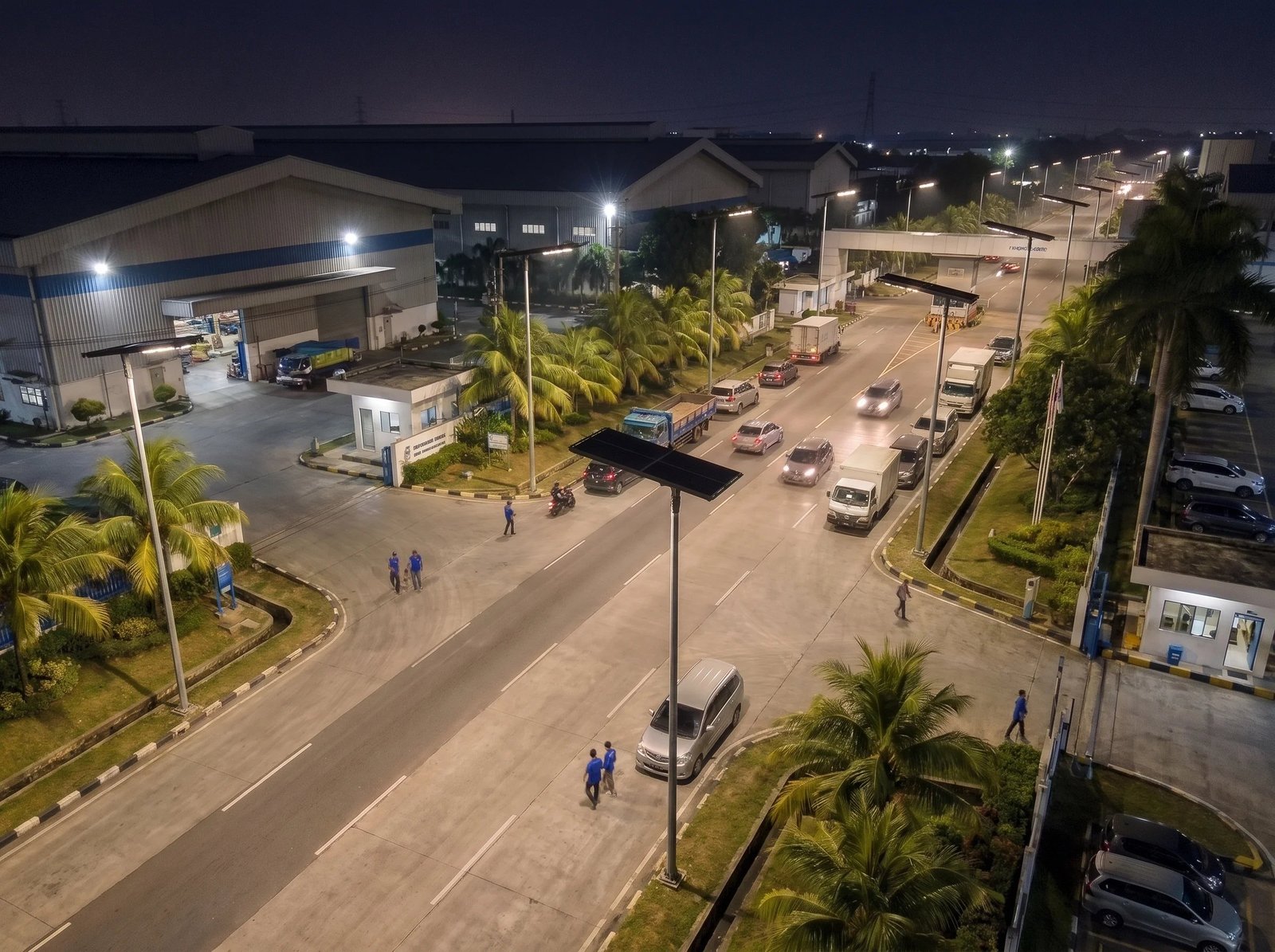
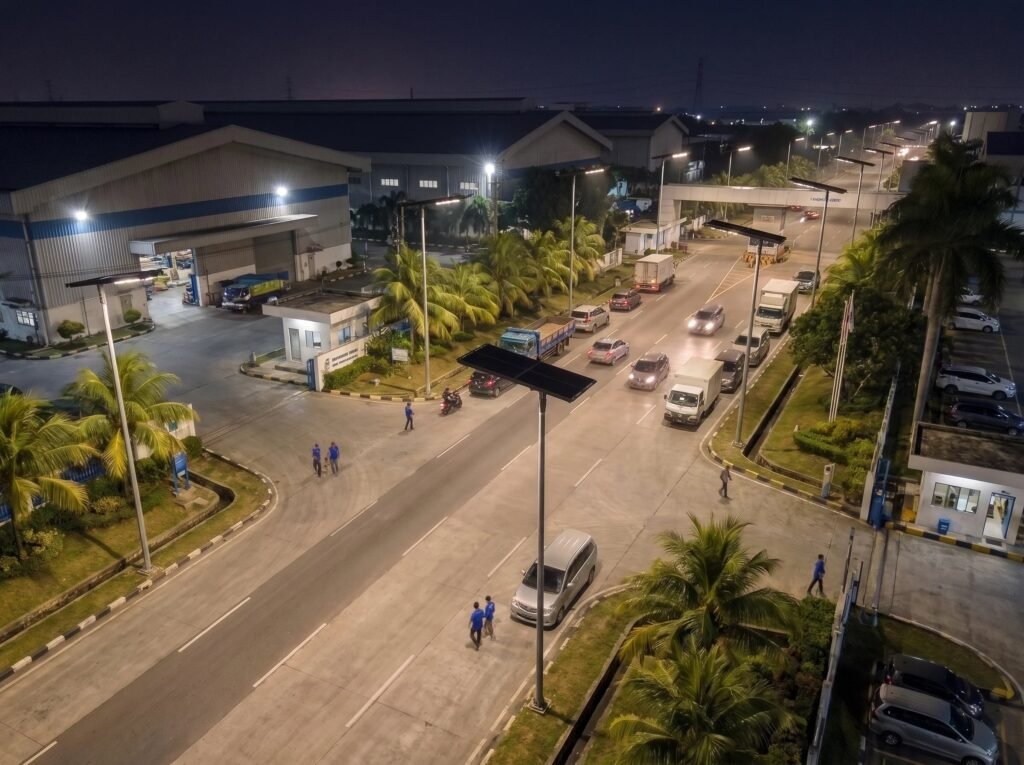
Roads used by trucks and delivery vans need strong, even light from taller poles. These areas usually call for higher-output systems with generous battery capacity, so the lights stay bright through long nights and cloudy weeks. On these roads, split type solar street lights are a common choice, because the separate solar panel can be larger and tilted towards the sun, giving more power and more nights of backup than a compact unit.
Loading bays and yards
Loading areas need wide, uniform light so staff can see vehicles, forklifts and each other clearly. Poles are often placed at the edge of the yard, so lights with a forward-throw beam pattern work well, keeping the light on the working area rather than on neighbouring plots.
Car parks
Staff and visitor car parks need even light across the whole area for safety and to support CCTV. Poles in the middle of a car park often use a round or square beam pattern, while poles along the edge use a forward-throw pattern.
Perimeter fences and gates
Security lighting along fences and at gatehouses should be reliable above all else. Independent solar lights are useful here because a single fault does not black out a whole stretch of fence.
Plan With a Lighting Design
The most common mistake on large sites is spacing poles by habit, such as one every 30 metres. The right spacing depends on pole height, road width, the beam pattern and the light level each area needs. A lighting calculation for the actual site layout shows where each pole should go and which fitting to use, and it gives owners and insurers evidence that the lighting meets the required standard.
Specialist suppliers of solar lighting for industrial and logistics sites usually provide this design as part of a project, together with the photometric files that consultants use to check the result.
Questions to Ask Suppliers
- How many nights can each light run without sun in our worst month of the year?
- What battery chemistry is used, how large is it, and how long is it expected to last?
- Can the lights dim during quiet hours, and can the schedule be changed later?
- Will you provide a lighting layout and calculation for our actual site plan?
- What wind rating do the poles and foundations have, including the solar panel?
- What warranty covers the battery, LED, panel and controller, and how are claims handled?
- Are spare parts available, and how quickly can they be delivered?
- Is remote monitoring available, so we can see faults before tenants report them?
Security and Vandal Resistance
On industrial sites, lighting is part of the security system. Lights should be hard to tamper with: batteries mounted at height rather than at ground level, anti-theft fixings, sealed housings and impact-resistant covers. Good lighting at gates, fences, fuel stores and bicycle racks also makes CCTV footage far more useful.
Phasing the Upgrade
Few managers replace every light on a site at once. A phased approach spreads the cost and lets tenants see the benefits early. Good places to start include:
- Areas with failing or damaged cables, where repairs would mean trenching anyway.
- New car parks, yards or roads that have no lighting yet.
- Dark spots that generate complaints or security incidents.
- Perimeter sections where independent lights improve security.
Before ordering, walk the site at night with a plan of the property. Mark dark areas, trees that might shade solar panels, and any places where tenants have raised concerns. This simple survey makes the supplier’s lighting design far more accurate.
Maintenance on a Large Site
Solar lights need much less maintenance than cabled systems, but on a site with dozens or hundreds of poles, a simple routine is still essential:
- Panel cleaning: dust from trucks and nearby works settles on panels and reduces charging, so industrial sites often need cleaning more often than residential ones.
- Regular night checks: a walk or drive round every few months spots lights that are dim or out.
- Battery planning: include battery replacement in the long-term maintenance budget.
- Asset records: keep a list of every light with its location, model and installation date, which also helps with insurance and audits.
Making the Business Case
When presenting solar lighting to owners or a board, the strongest case combines several benefits: lower and more predictable running costs, no trenching through busy operational areas, fewer emergency call-outs, better security and a clear sustainability improvement. Ask suppliers for a lifetime cost comparison that includes battery replacement and maintenance, not just the purchase price. A cheaper light that fails in its second winter quickly becomes the most expensive option.
Frequently Asked Questions
Are solar lights bright enough for truck routes?
Yes, when the system is sized correctly. Higher-output lights on taller poles, with large panels and batteries, are used on industrial roads, ports and logistics parks around the world.
Can existing poles be reused?
Sometimes. If the poles are in good condition and strong enough to carry a solar panel’s weight and wind load, solar fittings can be retrofitted. A structural check confirms this.
What happens during long cloudy periods?
Well-designed systems are sized for the worst month of the year and include several nights of battery backup. Smart dimming during quiet hours stretches that reserve further.
Final Thoughts
For property managers responsible for industrial and commercial sites, solar street lighting turns outdoor lighting from a recurring cost and maintenance headache into a reliable, low-running-cost service. Treat each area of the site on its own terms, insist on a proper lighting design, choose robust systems for the busiest roads and plan a simple maintenance routine. The result is a safer, better-lit property that tenants notice and owners appreciate.