Sacramento and its surrounding region have a substantial industrial heritage processing facilities tied to the Central Valley’s agricultural economy, rail yards and logistics facilities that have served as major distribution nodes since the mid-19th century, manufacturing plants and food processing facilities that defined the region’s economic base for much of the 20th century. As industrial activity has evolved, consolidated, or relocated, many of these older industrial structures have been vacated and require demolition before the land can be reused. Industrial Demolition Sacramento is categorically different from residential or commercial work in its scale, structural complexity, hazardous material profiles, and environmental compliance requirements.
What Defines Industrial Demolition
Industrial demolition addresses the removal of manufacturing plants, processing facilities, warehouses, food processing operations, utilities infrastructure, and other large-scale industrial structures. In the Sacramento Valley context, significant categories include agricultural processing facilities canneries, dehydrators, packing houses, and cold storage plants that served the valley’s fruit and vegetable industry; rail-related facilities including maintenance shops, locomotive facilities, and freight yards; and the Sacramento Army Depot and McClellan Air Force Base, whose decommissioning generated substantial industrial demolition activity across the metro area.
The scale of industrial buildings in Sacramento dwarfs most residential and commercial structures. Industrial facilities may cover hundreds of thousands of square feet, span multiple building systems and construction vintages, and contain embedded process infrastructure tanks, piping systems, cranes, overhead monorails, floor trenches, and pit structures that residential and commercial demolition crews never encounter. This complexity requires demolition contractors with specific industrial experience and equipment capacity.
Hazardous Materials in Sacramento Industrial Demolition
The hazardous material profile of industrial buildings reflects decades of industrial activity within them. Asbestos was used extensively in industrial construction for pipe insulation, boiler insulation, duct insulation, fireproofing on structural steel, roofing, and flooring products. A large Sacramento industrial facility built or expanded in the 1950s through 1970s may contain hundreds of thousands of linear feet of asbestos-insulated pipe and equipment. Pre-demolition asbestos abatement for industrial facilities is a massive undertaking that can exceed the cost and duration of the structural demolition itself.
PCBs (polychlorinated biphenyls) are present in electrical transformers, capacitors, and certain hydraulic fluids in many older Sacramento industrial facilities. PCBs are federal Superfund-listed hazardous substances under CERCLA, and their removal and disposal requires specific regulatory compliance under EPA rules. Petroleum hydrocarbons from decades of equipment lubrication, fuel storage, and vehicle maintenance contaminate soils beneath industrial facilities throughout Sacramento’s industrial corridor.
Lead-based paint on structural steel is another significant consideration. Industrial structural steel was routinely painted with lead-based primer and topcoat for corrosion protection. Cutting and burning through lead-painted steel during demolition using torches or shears generates lead fumes that create acute health hazards for workers. OSHA’s Lead Standard (29 CFR 1926.62) establishes specific exposure limits and worker protection requirements for lead in demolition work that experienced industrial contractors comply with as standard practice.
Regulatory Complexity in Sacramento Industrial Demolition
Industrial demolition in Sacramento engages multiple regulatory agencies simultaneously. The Sacramento Metropolitan Air Quality Management District regulates asbestos demolition notifications and dust emissions from demolition activity. The California Department of Toxic Substances Control (DTSC) oversees the management and disposal of hazardous waste including asbestos waste, PCB-containing materials, and petroleum-contaminated material. The Sacramento Regional Water Quality Control Board has jurisdiction over stormwater quality and any discharge to waters of the state. OSHA and Cal/OSHA govern worker safety requirements on industrial demolition sites.
For former public agency facilities military bases, county facilities, state properties additional environmental review processes under CEQA and the National Environmental Policy Act (NEPA) may apply, along with specific requirements tied to the public agency’s decommissioning process. McClellan Park and other Sacramento-area former military and government facilities have established specific environmental management frameworks for their redevelopment that shape the approach to demolition work on those sites.
Industrial Demolition Methods in Sacramento
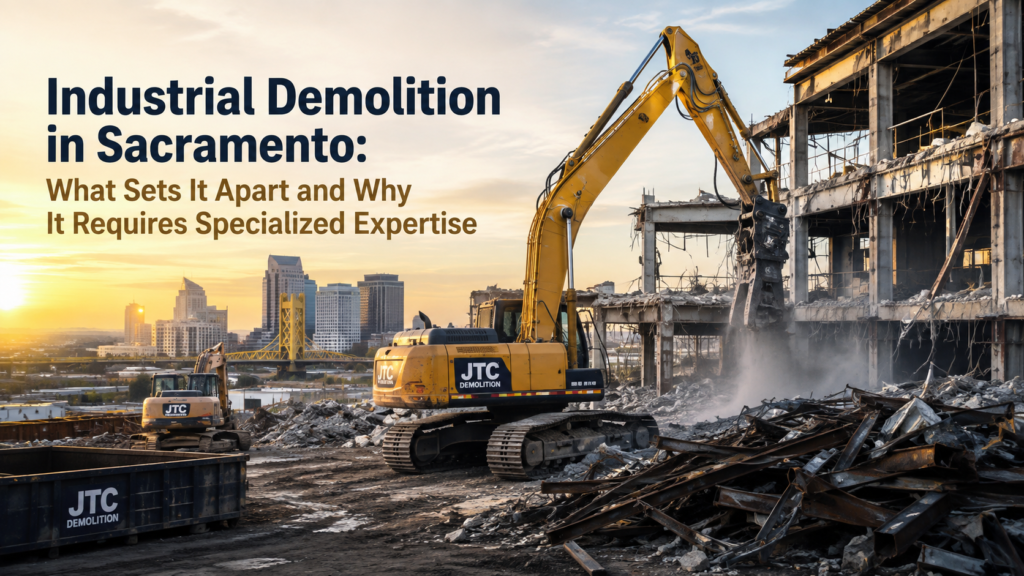
Mechanical demolition with large excavators typically in the 50-to-100-ton class or larger is the primary approach for Sacramento industrial structures. High-reach excavators with extended boom configurations can work from the top down on multi-story industrial buildings, using demolition shear or grapple attachments to cut, grip, and pull structural elements. This top-down approach manages the collapse zone and allows systematic material sorting as the structure is dismantled.
Structural steel from Sacramento industrial demolitions is one of the most valuable recovered materials. Industrial buildings with significant structural steel content can generate hundreds or thousands of tons of scrap steel that carries market value through Sacramento-area scrap yards. This steel scrap value partially offsets demolition costs and represents the largest recycling stream from industrial demolition projects in the region.
Common Questions About Industrial Demolition in Sacramento
How long does industrial demolition take in Sacramento? Industrial demolition timelines in Sacramento are highly variable depending on facility size, hazardous material burden, and environmental compliance requirements. Small industrial buildings may be demolished in a few days. Large facilities with significant asbestos abatement requirements may require months of abatement work followed by months of structural demolition.
What is brownfield redevelopment and how does it relate to Sacramento industrial demolition? Brownfield redevelopment refers to the cleanup and reuse of former industrial sites with known or suspected contamination. Sacramento has multiple active brownfield programs administered through DTSC, the Sacramento Housing and Redevelopment Agency, and federal EPA that provide financial and regulatory assistance for qualifying brownfield projects. Industrial demolition is typically the first physical step in brownfield redevelopment.